
Do enclosed fittings shorten LED bulb life?
Inside a fully closed shade the air heats up, and the LED driver suffers for it. When there is a risk, what the packaging symbol means and what you can do.
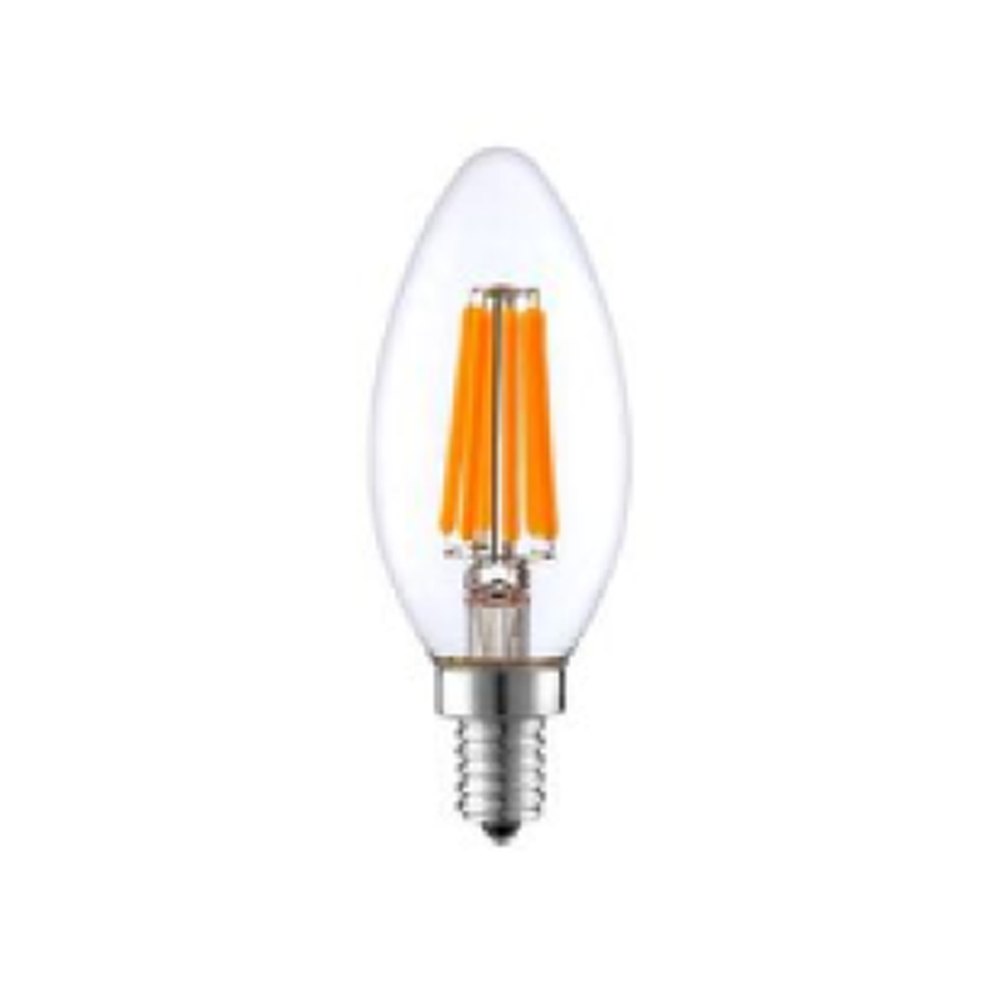
A glass globe on the ceiling, a closed wall light, a sealed fitting in the bathroom: in many homes the bulb is covered on every side. In the incandescent era that simply meant a hot shade. For an LED bulb an enclosed space is a more serious matter, because its electronics are far more sensitive to heat than a filament ever was.
What happens inside a closed shade
In an open fitting, heat from the bulb's body rises, cooler air takes its place, and that circulation carries on continuously. Inside a closed shade the air does not circulate. Once the bulb is on, the temperature inside the shade climbs gradually and settles at a certain level, which can be well above room temperature.
A bulb's heat sink is designed to pass heat into the surrounding air. When that air is already hot, the flow of heat weakens and the temperature of the body, the board and the driver rises. The bulb ends up running in hotter conditions than it was designed for.
Why the driver takes the hit
LED chips can tolerate a fair amount of heat, but the electrolytic capacitors in the driver are especially temperature-sensitive. A rule of thumb widely used in electronics says that for every rise of about 10 degrees in operating temperature, the expected life of such capacitors roughly halves. It is not an exact formula, but it points in the right direction: even a few degrees make a difference over time.
That is why, in a closed shade, a bulb usually stops working because its driver fails rather than because its light has faded. Some bulbs have thermal protection: when the temperature passes a limit, the bulb dims or switches off temporarily. That protects the bulb, but to the user it looks as if the light turns itself off.
What the packaging symbol tells you
Manufacturers indicate on the packaging whether a bulb may be used in an enclosed fitting. This is usually shown with a luminaire symbol, either as an approval mark or crossed out. Sometimes there is wording such as "not for enclosed fixtures".
If there is no marking, it is wiser to be cautious and assume the bulb is not intended for enclosed shades. Keep in mind too that the hour figure on the box usually refers to particular test conditions, often open-air operation.
Which fittings are riskier
Not every covered fitting carries the same risk. Several factors affect it:
- volume: air heats quickly inside a small globe or narrow cylinder, while a large shade spreads the heat over a bigger area;
- sealing: sealed bathroom fittings with rubber gaskets have almost no air exchange;
- material: glass and metal conduct heat slightly better than plastic, though not enough to be decisive;
- mounting: in a flush ceiling fitting hot air cannot escape upward, while around a pendant air can move past the edges;
- bulb wattage: in the same shade, a high-output bulb produces far more heat than a low-output one.
Closed wall lights holding small candle bulbs and decorative night lights also belong on this list. Their bodies are small, so they have less opportunity to spread heat.
Practical solutions
If you do not want to replace the fitting, there are several ways to reduce the risk:
- choose a bulb that is marked as suitable for enclosed fittings;
- do not use a stronger bulb than necessary; work out how much light the room needs and pick the wattage to match;
- in a multi-bulb shade, use fewer bulbs that still give enough light instead of filling every socket;
- if the shade has a small ventilation gap underneath or at the side, do not block it;
- where possible, prefer fittings that are open underneath or let air through at the edges.
These tips matter most where lights stay on for a long time, such as hallways, stairwells and lights left on at night, because the inside of the shade stays hot for hours.
When the fitting itself should go
Repeated early failures in one shade, or yellowing glass and holder, point to the fitting itself, whatever bulb you use. In that case, switching to a fitting designed for LEDs, with good heat dissipation, can be the long-term answer.
When choosing a new fitting, look for a few signs: ventilation holes in the body, enough space between the bulb and the walls of the shade, and a base that is open or easy to remove. In damp places such as bathrooms, where the seal has to be kept, fittings designed for those conditions that shed heat through their body are the better choice.
A simple check is also useful: after the light has been on for a few hours, switch it off and carefully touch the glass of the shade. If the glass is too hot to keep your hand on, the bulb inside is working in tough conditions, and the advice above applies to that spot in particular.
For small shades, anyone looking for a compact bulb can check models such as the C37 candle with an E14 cap and the C45 with an E27 cap in the Zəfər İşığı catalogue. All the listed products come from the company's Ganja plant.
All news