
SMD, COB and filament: the types of LED light source
The single word "LED" covers quite different designs. How SMD, COB and filament light sources are built, and where each of them works best.
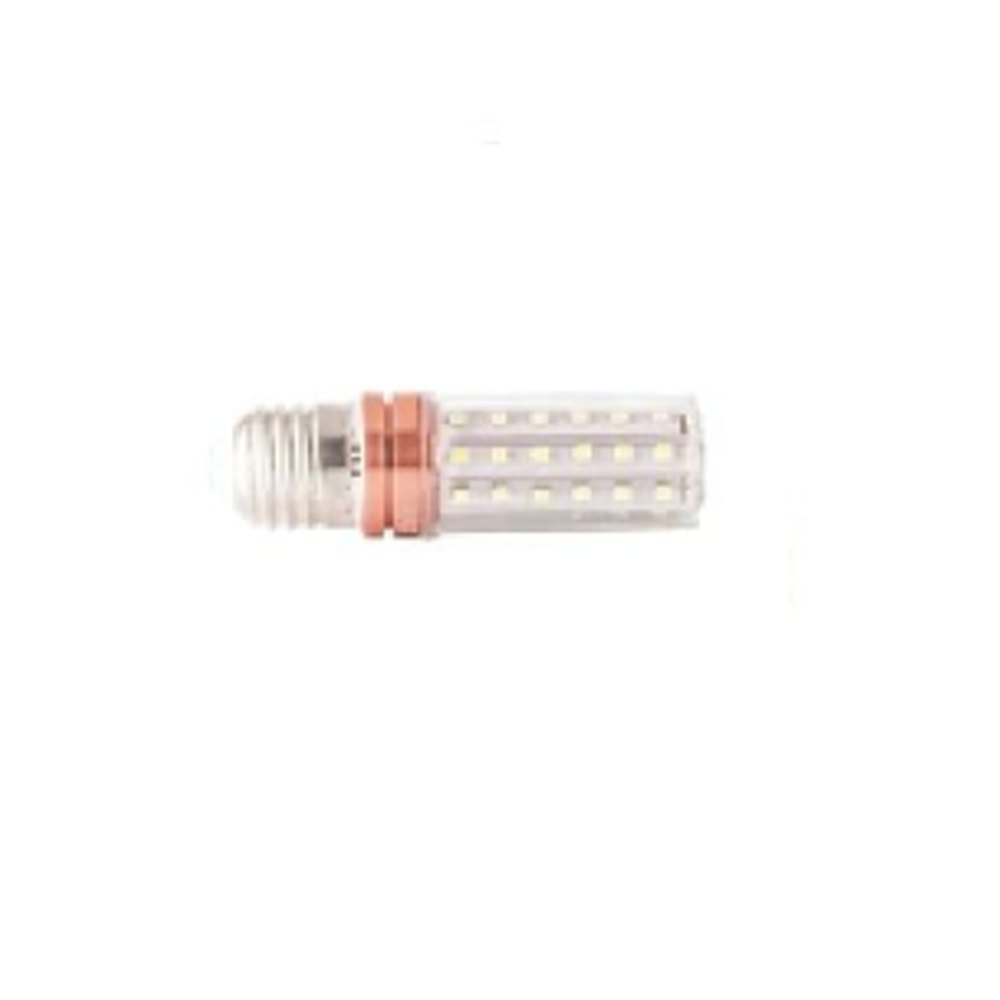
You look at two LED bulbs in a shop: one has thin yellow strands visible through clear glass, while nothing at all can be seen under the frosted cover of the other. One spot lamp is covered in dozens of little yellow squares, another has a single round patch of light. They are all LEDs, but the light source is built differently in each. The terms SMD, COB and filament describe exactly that difference.
SMD: surface-mounted diodes
SMD stands for "surface-mounted device". Each SMD LED is a separate tiny package: one or more chips inside, a phosphor layer on top, and contacts underneath that are soldered to a board. A bulb has anything from a few to dozens of these diodes laid out on a board.
Numbers you often see, such as 2835 or 5730, usually refer to the package size: a 2835, for example, measures roughly 2.8 × 3.5 millimetres. The number says nothing directly about light quality or power.
The strengths of SMD:
- heat spreads over a large area of the board and works well with a heat sink;
- the diodes can be arranged in many shapes, such as circles, cylinders or lines;
- it is widely used in manufacturing and therefore very versatile.
Its weakness is that each diode is a separate point source. Without a frosted cover, the light looks dotted and dazzling. That is why in standard A-shape bulbs the SMD board is normally covered with a diffusing dome. "Corn" bulbs, with SMD diodes lined up along a cylinder, are another good example of this type.
COB: many chips on one board
COB means "chip on board". Here the chips are not placed in individual packages but mounted closely together directly on a shared substrate and covered with a single continuous phosphor layer. From outside it usually looks like a yellow circle or square.
The advantages of COB:
- light comes from one evenly glowing area, giving one crisp shadow instead of many small ones;
- it is easy to shape the beam precisely with a lens or reflector, which is why it is common in spots and floodlights;
- high light output can be achieved from a small area.
There is a downside: all the heat is concentrated in a small area, so a COB source needs a strong, properly designed heat sink. When the heat sink is inadequate, COB is the type that suffers first. Looking straight at the bright little surface is also dazzling, so it is best hidden behind optics or a deep housing.
Filament: the old look, new technology
In a filament LED the chips are lined up along a thin, long strip of glass, sapphire or flexible substrate and coated with phosphor. The result is a yellow strand resembling the filament of an old incandescent bulb. One bulb holds several such strands.
Features of filament sources:
- light spreads in every direction, creating a lovely sparkle through clear glass and in chandelier crystals;
- the classic bulb look suits decorative and open fittings;
- there is no metal heat sink; heat leaves mainly through the gas inside the bulb and the glass.
That last point is also a limitation. With less capacity to shed heat, filament bulbs are usually made in low to medium outputs, and in small closed shades they need particular attention to heat. Looking directly at the strands through clear glass can be harsh, so they look more comfortable in fittings with shades or mounted higher up.
Colour and evenness of light
In all three types, white light is produced the same way: a chip emitting blue light is coated with phosphor, the phosphor converts part of the blue light into yellow and red tones, and the eye sees white. Colour temperature and colour rendering depend mainly on the phosphor composition. So these properties are determined more by the materials used than by whether the source is SMD, COB or filament.
The difference shows in how the light is distributed. Being a single area, COB gives an even colour across its surface. Many SMD diodes may differ slightly from one another, but a diffusing dome hides that. In a filament bulb the light spreads in all directions, so small variations are practically unnoticeable at room scale.
Which suits where
- General room light, ceiling fittings: an SMD board under a diffusing dome gives even, soft light.
- Spots, display cases, directional light: COB or SMD with a lens directs the light precisely.
- Chandeliers, open wall lights, decorative pendants: filament bulbs look attractive in clear glass.
- Large spaces, warehouses, garages: large-bodied, high-output bulbs with many SMD diodes.
Reminders when choosing
The type of light source is a design choice, not a measure of quality in itself. Every type includes good and poor products. When deciding, look beyond the source type at the light output, colour temperature and cap shown on the packaging, and at the conditions in the fitting.
The Zəfər İşığı range from Zaferoğlu Elektrik covers different forms, including standard A-shape bulbs, a corn lamp, E14 filament lamps and spot lamps. Filtering the catalogue by shape helps you work out which model suits your fitting.
All news