
How a filament LED bulb is built
A filament LED looks like an old incandescent bulb, but inside are LED strips, a phosphor coating, a gas-filled glass envelope and a tiny driver. Here is what each part does.
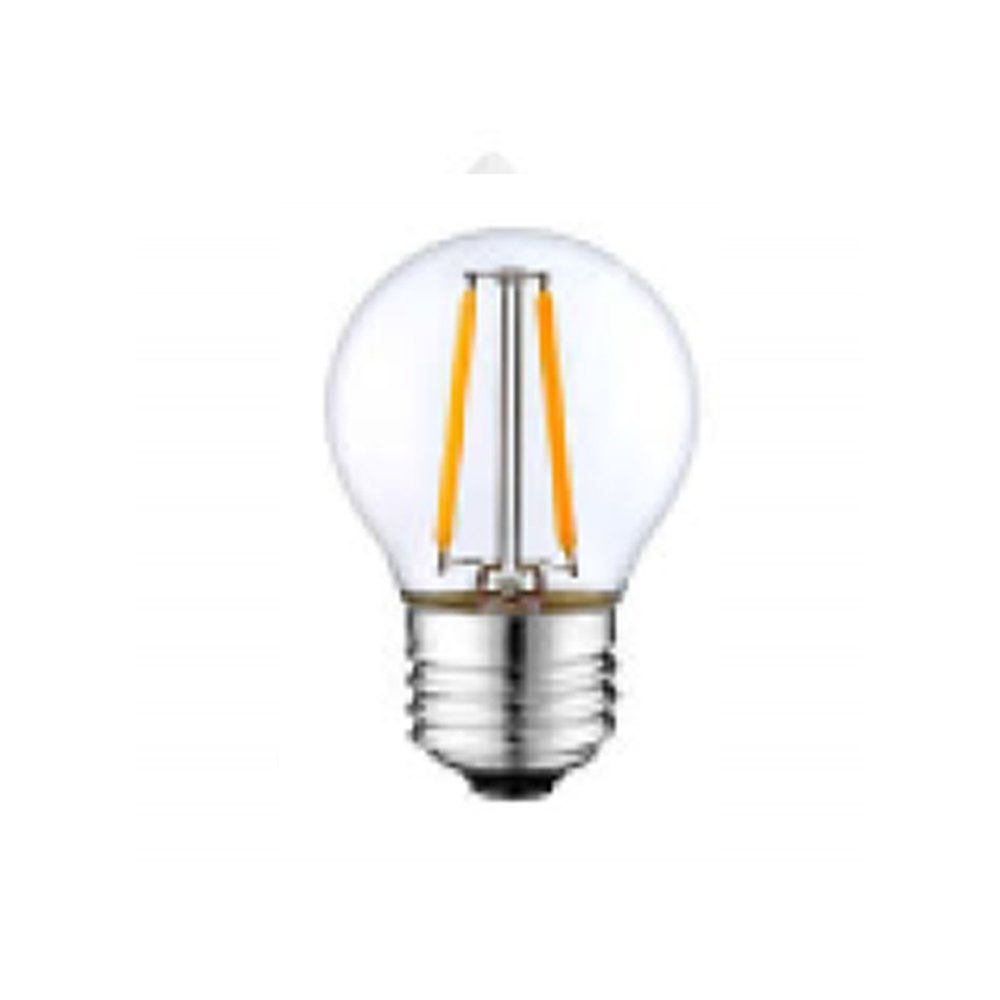
Look at the thin glowing threads inside a clear filament bulb and it is easy to assume you are seeing a descendant of Edison's lamp. In fact those threads are not metal wire at all. Each one is a narrow strip carrying dozens of microscopic LED chips. A filament LED marries a vintage look to semiconductor lighting, and that combination comes with its own design logic.
What sits inside each strip
Every "filament" is built in layers. At the bottom is a thin substrate, which may be glass, sapphire, ceramic or a flexible material. Small blue LED chips are mounted along it in a row and linked by very fine bonding wires. Because the chips are connected in series, the strip only lights when all of them are working.
The part that turns blue light into white is the yellowish coating wrapped around the whole strip: phosphor powder mixed into silicone. Some of the blue light is absorbed by the phosphor and re-emitted at longer, yellow and red wavelengths; mixed with the remaining blue, the eye perceives white. The recipe and thickness of that coating decide whether the light is warm or cool, and it is also why the strips look yellow when the bulb is switched off.
When the substrate lets light through, light leaves both faces of the strip. The bulb therefore shines in every direction, much like an incandescent lamp, whereas an ordinary LED bulb has its chips on a flat board and sends most of its light one way.
The envelope, the gas and where the heat goes
Like any LED, filament chips produce heat, and running too hot reduces both brightness and life. A standard LED bulb deals with this through an aluminium or plastic heat sink. A filament bulb has no such part, so the heat has to escape another way.
The glass envelope is usually filled with a gas that conducts heat better than air, such as a helium-based mixture. The gas carries heat from the strips to the glass, and the glass releases it to the room. That is why the envelope needs to stay intact: if the glass cracks and the gas escapes, the bulb may keep working for a while, but the strips run hotter and can fail early.
The strips are held on a small glass stem in the middle of the bulb by thin support wires. It resembles the structure of an old lamp, except here the wires are both mechanical supports and electrical conductors.
Where the driver hides
LED chips cannot run directly from alternating mains voltage; they need a regulated current. The electronic circuit that provides it, the driver, is squeezed into the cap or the neck of the bulb. With so little room it has to be simple and compact.
The quality of that driver shows up in everyday use:
- flicker, which on basic designs can appear as bands when you film the light with a phone;
- dimming, which only works properly when the packaging clearly says the bulb is dimmable;
- how quickly the bulb starts and how well it copes with an unstable supply.
How the design affects everyday use
Because the heat leaves mainly through the glass, a filament bulb needs some air around it. In a small, fully enclosed shade it will run hotter than in an open wall light or chandelier.
Glass does not like knocks. When fitting the bulb, hold it near the cap rather than by the envelope while screwing it in. A filament bulb that has been dropped may look fine and still have a bent support or a damaged strip inside.
The strips are visible, so a clear bulb can look like a set of bright points and cause glare when you see it directly. For lamps hanging at eye level, a frosted or amber envelope is usually more comfortable.
The number and layout of strips vary too. Small candle bulbs have one or two short strips, while large decorative bulbs can use flexible substrates bent into spirals, loops or even lettering. The layout affects light distribution: vertical strips send more light sideways, while horizontal or spiral ones spread it more evenly.
What a fault looks like
Knowing the construction also helps you read a failure. If one strip has gone completely dark while the others still glow, a chip or bonding wire on that strip has most likely failed; in a series chain, one broken link switches off the whole strip. If all strips flicker together or none light at all, the driver is the more likely culprit. Haze, spots or darkening inside the glass can mean the envelope has lost its seal. In all three cases the bulb cannot be opened and repaired; it needs replacing.
A short checklist before buying:
- do the cap and bulb shape suit the fitting;
- is the bulb approved for enclosed fittings;
- if there is a dimmer, does the packaging confirm dimmer compatibility;
- clear or frosted glass, depending on whether the bulb will be in direct view.
You can see this construction in Zəfər İşığı's E14 filament candles and flame-tip bulbs. Details of their shapes and caps are listed on the product pages.
All news