
The stroboscopic effect: why flicker is dangerous in workshops
Under flickering light, a spinning shaft can look stopped or slow. What causes the stroboscopic effect, the risk it creates in a workshop and how to prevent it.
A machinist standing at a lathe thinks the chuck has stopped and moves a hand towards it. In fact the spindle is turning at high speed; it just looks still under the lighting. This dangerous illusion is called the stroboscopic effect. It is rarely a problem in an ordinary home, but in production halls, workshops and anywhere mechanical work is done with rotating equipment, it is a serious safety issue.
How the effect arises
The mains frequency in Azerbaijan is 50 hertz, meaning the current changes direction 50 times a second. In many light sources the brightness varies with that cycle: once every half-cycle, or 100 times a second, the light rises and falls. Normally the eye does not see this rapid change as flicker.
A moving object under that light looks different, however. If the rotation rate of a spindle, circular saw, fan blades or wheel is close to the light's flicker frequency, or a multiple of it, the eye sees the object in the same position every time. As a result the rotating part appears stopped, turning slowly or even turning backwards. The wagon wheel that seems to spin in reverse on film works on the same principle.
Which light sources create a risk
The strength of the effect depends on how deeply the light fluctuates.
- Old fluorescent lamps with magnetic ballasts and other discharge lamps dim noticeably with every cycle. In the past, the stroboscopic effect in workshops was mostly linked to them.
- Incandescent lamps change very little, because the filament does not cool quickly.
- With LED lamps, everything depends on the driver. A good driver smooths the current and there is practically no flicker. In cheap, simplified drivers the light can drop very deeply with each cycle, which can be worse than old fluorescent lamps.
- In dimmed LED systems, especially those using low-frequency pulse width modulation, the effect can become stronger.
In other words, the assumption that switching to LED solved the problem is not always correct. When choosing LED fittings for a workshop, their flicker behaviour has to be checked separately.
What it puts at risk in a workshop
The main danger of the stroboscopic effect is that a worker misjudges the state of a rotating part:
- a hand, tool or loose clothing goes near a spindle, chuck or cutter that appears to have stopped;
- the motion of a saw blade or grinding wheel is not perceived correctly;
- it is not obvious that a conveyor or rotating machine is running;
- over time, flickering light causes eye strain, headaches and reduced attention, which increases the chance of mistakes.
The European standard EN 12464-1 lists avoiding flicker and stroboscopic effects as a specific requirement for workplace lighting. In Azerbaijan, occupational safety requirements are set by local regulations, but the logic is the same: workers must see moving parts as they really are.
Ways to prevent it
There are several approaches to reducing the risk, and they are often combined.
Choose low-flicker light sources. For LED fittings, manufacturers' data sheets give flicker metrics: Pst LM for short-term flicker and SVM for the stroboscopic effect. European Union ecodesign rules set limits for these values. If the data is missing, do a simple test before use in the workshop: watch a rotating object under the light and check for banding with a phone camera.
Upgrade old fluorescent systems. Replacing magnetic ballasts with high-frequency electronic ballasts or good-quality LED fittings practically eliminates the effect.
Spread fittings across phases. In older installations, connecting adjacent fittings to three different phases reduced the overall flicker. It can still be useful today as a temporary measure.
Fit local lighting on machines. Lighting the working area of a lathe, milling machine or saw with its own flicker-free lamp makes up for the weaknesses of the general lighting and lets the worker see detail better.
Brief the staff. It should be standard practice to confirm that a machine has stopped not by how it looks, but by the indicator on the control panel, by sound, and by waiting for the full run-down time.
Checklist
- List all rotating equipment in the workshop.
- Identify the type of light and the quality of the driver above each machine.
- Replace old fluorescent fittings with magnetic ballasts on a planned basis.
- Check the flicker metrics of new LED fittings in their documentation.
- Install local lighting on machines.
- Make sure dimmers and control systems do not introduce flicker.
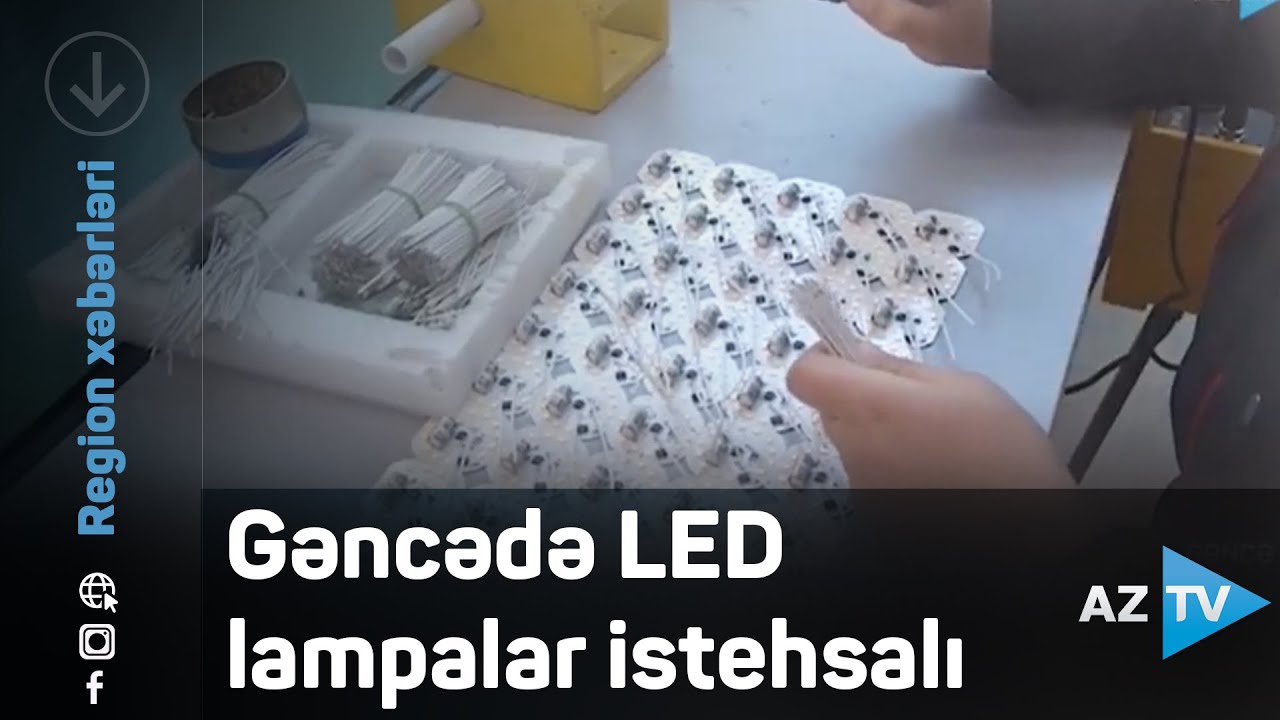
Zaferoğlu Elektrik's Zəfər İşığı lamps are made in Ganja, in premises that were once a garment factory. When choosing lamps for a workshop, the technical details of a specific model can be confirmed by sending an enquiry to the company.
All news