
Choosing lamp output for the height of the ceiling
The higher the ceiling, the less light the same lamp delivers below. How to think about output, lamp type and layout, from ordinary flats to warehouses and halls.
In a flat in an older building with a 3.5-metre ceiling, a new LED lamp goes in, yet the room stays as dim as before. In a warehouse dozens of lamps hang from the roof, but reading labels on the lower shelves is still a struggle. In both cases the problem is not the lamp itself; it was chosen without taking height into account.
How height affects light
Double the mounting height and the light reaching the floor drops to about a quarter. For a small source, raising a lamp from 2.5 to 3.5 metres roughly halves the light at the same point. Light reflected from walls and ceiling makes up some of the loss, but in tall rooms the ceiling itself is far from the source, so that help weakens too.
The second effect is spread. A wide-angle lamp mounted high covers a large area, but little light falls on each point. The result is a tall room with light that is "everywhere but weak".
Standard residential ceilings: 2.5–2.8 metres
Most modern flats fall into this range, and the usual calculations work:
- an ordinary pear-shaped LED bulb or wide-angle spotlights are enough;
- a medium room can be lit by a single ceiling lamp, though several sources give a more even result;
- a very bright bare lamp sits close to eye level and can cause glare.
High residential ceilings: 3–4 metres
These are found in older buildings, villas and double-height living rooms. There are several approaches:
- More output. Choose a lamp one or two steps stronger than you would for the same floor area under a normal ceiling. Simple, but remember the glare risk with bare lamps.
- Bring the light down. Lengthening a pendant cable brings the source closer to the work surface. Over a dining table this is the most effective method.
- Multiple sources. Add wall lights, floor lamps and table lamps to the ceiling light. In a tall room, light at a lower level adds both comfort and a homely feel.
- Medium-angle spotlights. A wide-angle spot scatters too much from 3.5 metres; a 36–40° beam gets the light down to the floor better.
Commercial and industrial heights: 4–8 metres
Shops, warehouses, workshops, sports halls and car services usually have high ceilings. Household lamps are not enough here, and higher-output sources are needed:
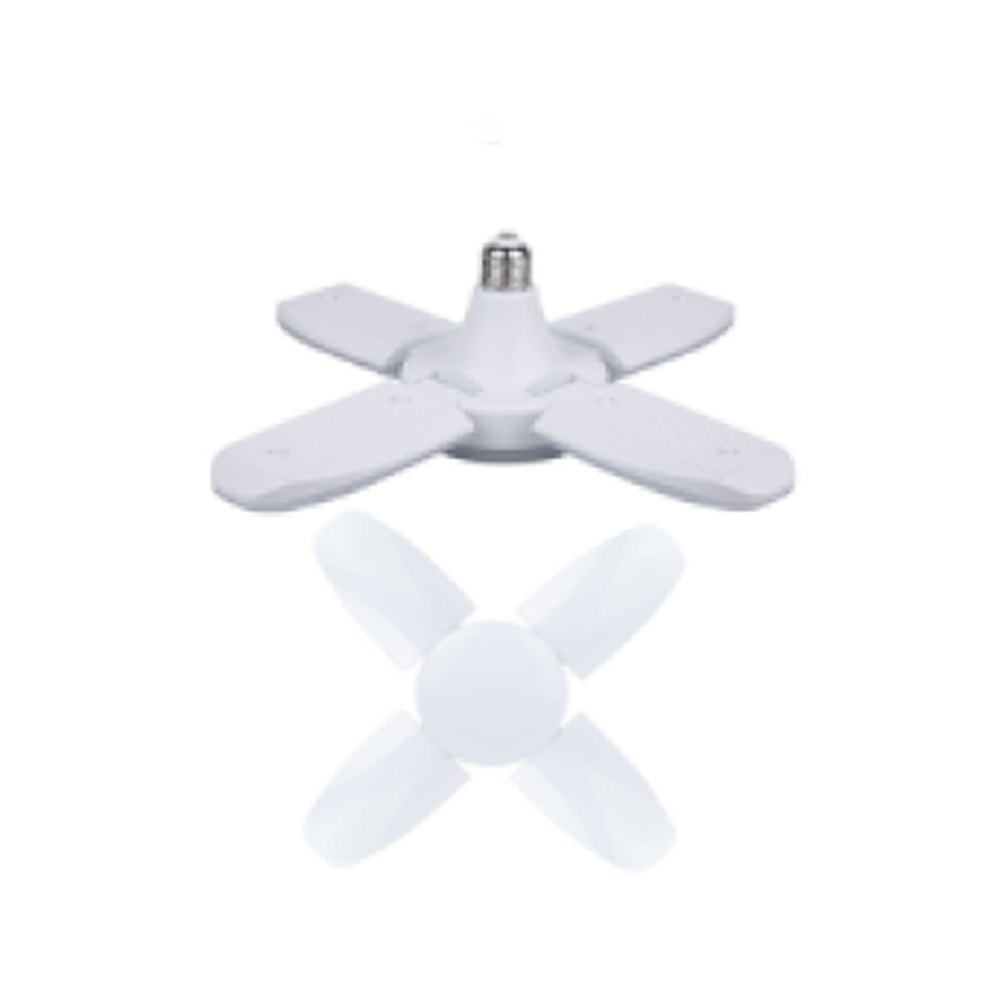
- large, high-output LED lamps, such as T-shape or folding multi-blade models;
- dedicated high-ceiling luminaires that use a reflector or lens to direct light downwards;
- linear luminaires installed in rows, especially between racks.
When choosing high-output lamps, check the lampholder too. A heavy, bulky lamp may not suit an ordinary plastic holder; if an adapter is used to go from E27 to E40, make sure it matches the lamp's power and weight.
Layout rules
Under high ceilings, the spacing between lamps determines how even the light is. A commonly used guideline is that the distance between luminaires should not exceed their mounting height. For example, lamps hung at 5 metres give even light when spaced about 4–5 metres apart, whereas at 8–10 metres dark zones appear between them. The exact ratio depends on the luminaire's light distribution and may be given in the manufacturer's data sheet.
In a warehouse with racking, light should fall into the aisles between racks, not onto the tops of the racks. Otherwise the lower shelves stay in shadow.
The forgotten factor: maintenance
Changing a lamp under a high ceiling takes a ladder and sometimes a lift. Where changing a bulb means a ladder or a lift, pick durable, well-cooled lamps and standardise on one type: spares are easier to keep and replace. Dust settling on lamps also reduces light over time, so periodic cleaning should be planned.
To sum up in a short checklist:
- Measure the ceiling height and the height of the surface to be lit.
- Work out the lumens needed for general light and add a margin for height.
- Match the beam angle to the height: the higher, the narrower.
- Check that the lampholder suits the lamp's power and weight.
- Think in advance about how you will reach and replace the lamps.
For tall halls, Zaferoğlu Elektrik produces T lamps in several ratings up to 70 W and a 4+1 lamp whose wings fold out.
All news