Corn LED bulbs: their shape, light spread and best uses
How a corn-shaped LED bulb is built, how it spreads light all around, and which kinds of fittings it works best in.
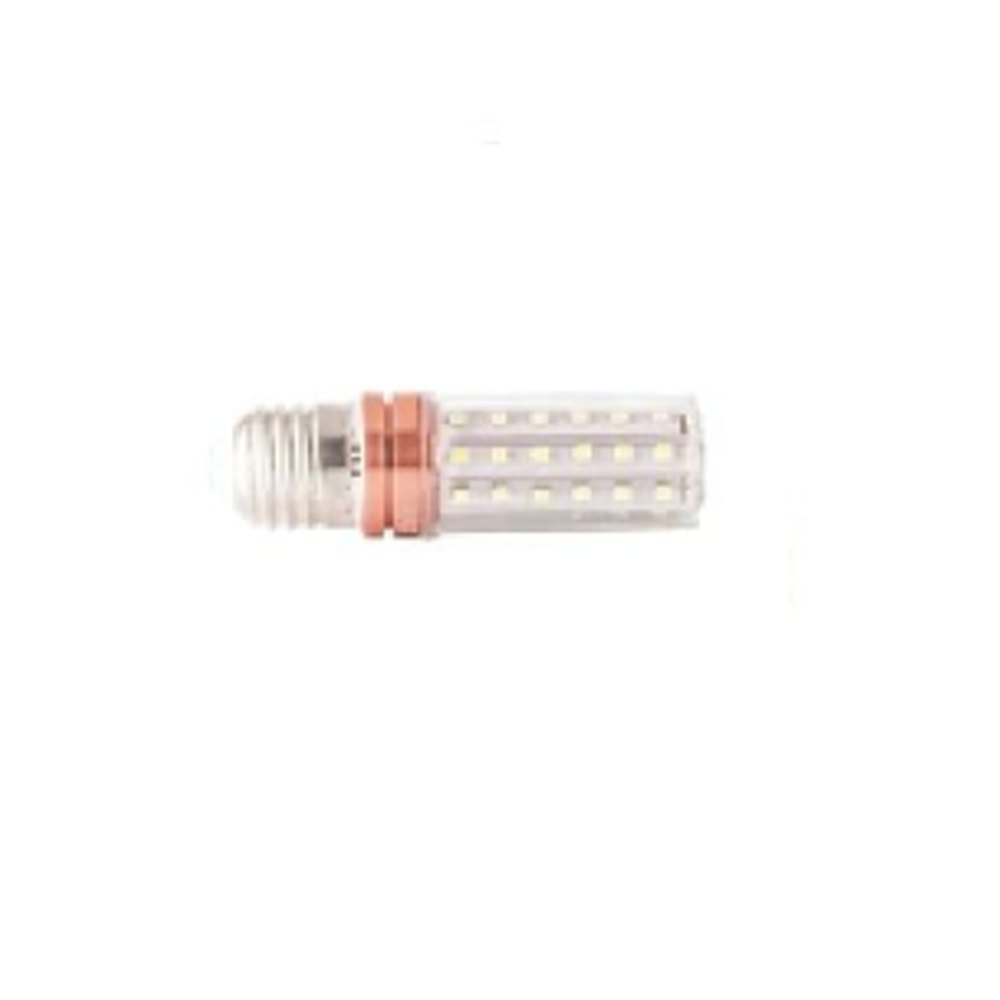
The name comes from the look: rows of small yellow diodes cover the whole surface of a cylindrical body, and the bulb really does resemble a corn cob. The shape is not a whim. It was designed to overcome one weakness of an ordinary LED bulb, namely that most of its light goes in one direction.
How it is built
At the heart of a corn bulb is a cylindrical or multi-sided body. The diodes are mounted on its sides and sometimes on the tip as well. Below sits an ordinary E27 or E14 cap, or an E40 for large spaces. The driver is housed inside the body.
Models fall into two main groups. In the first, the diodes are exposed with no cover. In the second, the body is enclosed in a clear or frosted plastic sleeve. Exposed-diode bulbs give slightly more light but are sensitive to dust and touch; covered versions look tidier and soften the light.
High-output corn bulbs may also have a small fan or ventilation openings inside the body so heat can escape.
How the light is spread
In a classic A60 LED bulb, the diodes sit on a flat board at right angles to the cap, and most of the light heads towards the tip. The area near the cap and the sides are lit relatively weakly.
In a corn bulb the diodes face every direction, so light spreads almost evenly around the bulb through 360 degrees. That is closer to the light distribution of old incandescent or mercury lamps. As a result, these bulbs direct light more correctly in fittings designed around such lamps, such as street lanterns with reflectors or garden lights glazed on the sides.
Where it works well
A corn bulb gives the best results in these cases:
- Fittings with reflectors. Street and yard lanterns and industrial bell fittings are designed to catch light from the sides and reflect it downwards. A bulb that emits sideways makes full use of the reflector.
- Bare bulbs. In a warehouse, garage or basement, a bulb hanging from a holder needs to light its surroundings in all directions.
- Glazed lanterns. In wall and post-top lanterns, light comes out evenly through every pane.
- Decorative use. Low-wattage, warm-white corn bulbs look interesting in open fittings with glass globes.
For a ceiling light with a downward-facing shade, however, a corn bulb brings no particular advantage, as part of the sideways light is lost inside the shade.
When upgrading old street lanterns, a corn bulb is one of the most popular options because it lets you replace just the lamp without changing the lantern. There is one point to watch, though: if the old lantern ran a mercury or sodium lamp, it may contain a ballast or ignitor. In such a circuit an ordinary mains LED bulb cannot simply be screwed in; those components must first be removed from the circuit. This is a job for an electrician, as lanterns are usually mounted high and outdoors.
What to watch out for
Glare. Looking directly at an exposed-diode bulb is very uncomfortable, as each diode is a small, bright point. At eye level or where people sit, choose a covered model or a fitting with a diffuser.
Size. Corn bulbs are often longer than ordinary bulbs. In an enclosed lantern, check the length so the bulb does not touch the glass and sits at the focus of the reflector.
Heat. On high-output models, ventilation openings must not be blocked. A high-output corn bulb can overheat in a small, fully sealed lantern.
Dust. Dust collects between exposed diodes and reduces the light. It helps to clean the bulb from time to time with a dry soft brush, once it is switched off and cool.
Weight. Long, high-output models put extra load on the holder, which matters on a pendant.
Quick questions before choosing
- Does the fitting collect light from the sides and reflect it, or does the bulb face straight down?
- Is the bulb at eye level or mounted high?
- How much length is available for the bulb inside the lantern?
- Do you need warm or neutral light?
The Zəfər İşığı catalogue offers a low-wattage, warm-light corn LED bulb. For decorative lanterns and fittings that need sideways light, you can compare its dimensions on the product page and choose accordingly.
All news