
Large LED bulbs: can an E27 lampholder take the weight?
How the weight of high-output LED bulbs affects the lampholder, the cable and the fitting, and when extra precautions are needed.
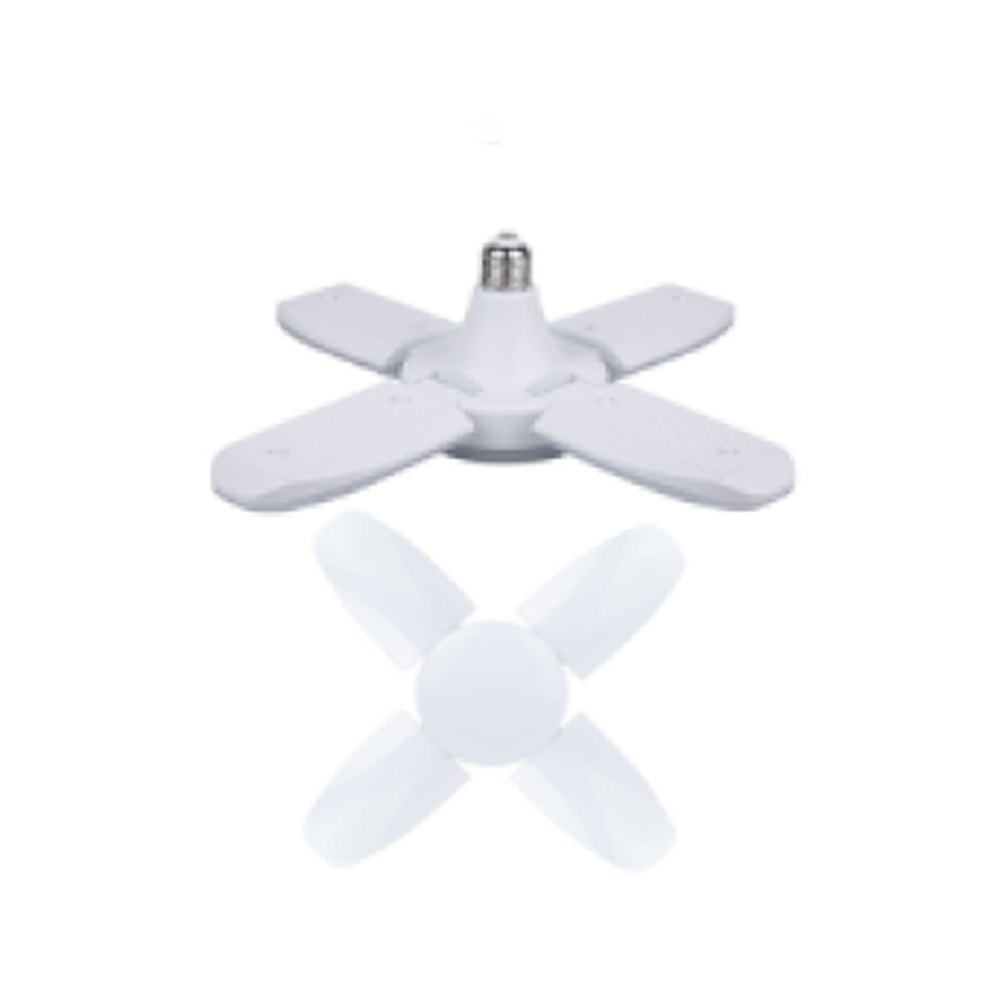
Many people buying a high-output LED bulb for a warehouse, garage or shop are surprised when they pick it up: it is much heavier than an ordinary household bulb. The obvious question follows. Can an old lampholder, especially a simple one hanging on a cable, carry that load? The answer depends less on the weight itself than on how and in what position the bulb is mounted.
Where the weight comes from
LED chips are extremely light. What makes the bulb heavy are the parts needed to carry away the heat they generate. High-output bulbs have an aluminium plate and heat sink behind the diodes, and the body is often a finned metal cylinder. The higher the wattage, the more heat sink surface is needed, otherwise the bulb cooks itself. Add larger driver components and a thick diffuser.
The result is that a high-output cylindrical or folding multi-blade LED bulb can weigh several times as much as an ordinary bulb with the same E27 cap. E27 lampholders never faced such loads in the incandescent era: even a 200-watt incandescent bulb was made of thin glass.
What happens in the lampholder
The threaded shell and central contact of an E27 holder are designed for the electrical connection. When a bulb is screwed in, its weight rests on the threads. If it hangs vertically with the cap at the top, the load is spread evenly along the thread, and for a good-quality holder that is usually not a problem.
The risk grows in other situations:
- The bulb points sideways. On a wall bracket or an angled arm, a heavy bulb acts like a lever and concentrates the load on one side of the thread.
- The holder is old, heat-aged plastic. Plastic exposed to heat for years becomes brittle, and the point where the shell is fixed can crack.
- The contact is loose. The weight pulls the bulb slightly out of the thread, the contact weakens, and heating and flicker follow.
- The bulb is subject to vibration. Near fans, roller doors or machinery, constant movement gradually loosens the thread.
A holder hanging from a cable
The most vulnerable arrangement is the simple pendant: a cable drops from the ceiling with a holder and bulb on the end. Here the weight passes from the holder to the cable, and from the cable to the terminals inside the holder. Terminals are made for electrical contact, not for carrying loads. The weight of a heavy bulb can gradually pull a conductor out of its terminal or loosen the connection.
Good pendant holders have a cord grip inside that clamps the cable. The cable should pass through that grip and reach the terminals slack, without tension. If there is no grip, do not hang a heavy bulb on the bare cable; transfer the load to the ceiling with a hook, chain or steel wire.
What to check and how to decide
Before fitting a large bulb, run through a few simple checks:
- is the holder ceramic or plastic, and if plastic, is it free of discolouration and cracks?
- does the bulb screw in smoothly without wobbling?
- is the holder fixed firmly to the fitting, rather than spinning?
- on a pendant, does the cable pass through a cord grip?
- in what position will the bulb run: facing down, sideways or up?
If the box states the bulb's weight or a recommended mounting position, follow it. Some manufacturers recommend cap-up mounting only for their heavier models.
Alternative solutions
Where a lot of light is needed, there are other options than loading one heavy bulb onto a weak holder. Two or three medium-output bulbs instead of one powerful bulb spread the load and even out the light as well. Industrial fittings use larger holders such as E40, which suit heavy lamps better. In some cases, a complete LED fitting with its own housing and fixings is the more reliable choice.
Splitter adapters that turn one E27 socket into several are not a good idea for heavy bulbs: they concentrate both weight and heat at a single point.
Do not treat the job as finished once the heavy bulb is in. Once or twice in the first few weeks, with the light switched off and the bulb cool, check that it is still seated as firmly as before. On a pendant, see whether the cable has slipped in its grip or the holder body has started to tilt. If the light begins to flicker or you notice a burning smell near the holder, switch off at once and inspect the holder and the wire connections. This simple routine catches a small problem before it turns into a serious fault.
The Zəfər İşığı catalogue includes high-output T-shape lamps from 20 to 70 watts and the folding 4+1 multi-blade lamp. When choosing lamps like these, assessing the holder and the mounting method in advance protects both the lamp and the fitting.
All news