
GU10 vs GU5.3 spotlights: how to tell the bases apart
Two spotlights of the same size can run on completely different supplies. How to tell GU10 from GU5.3 by the pins, the voltage and the fitting itself.
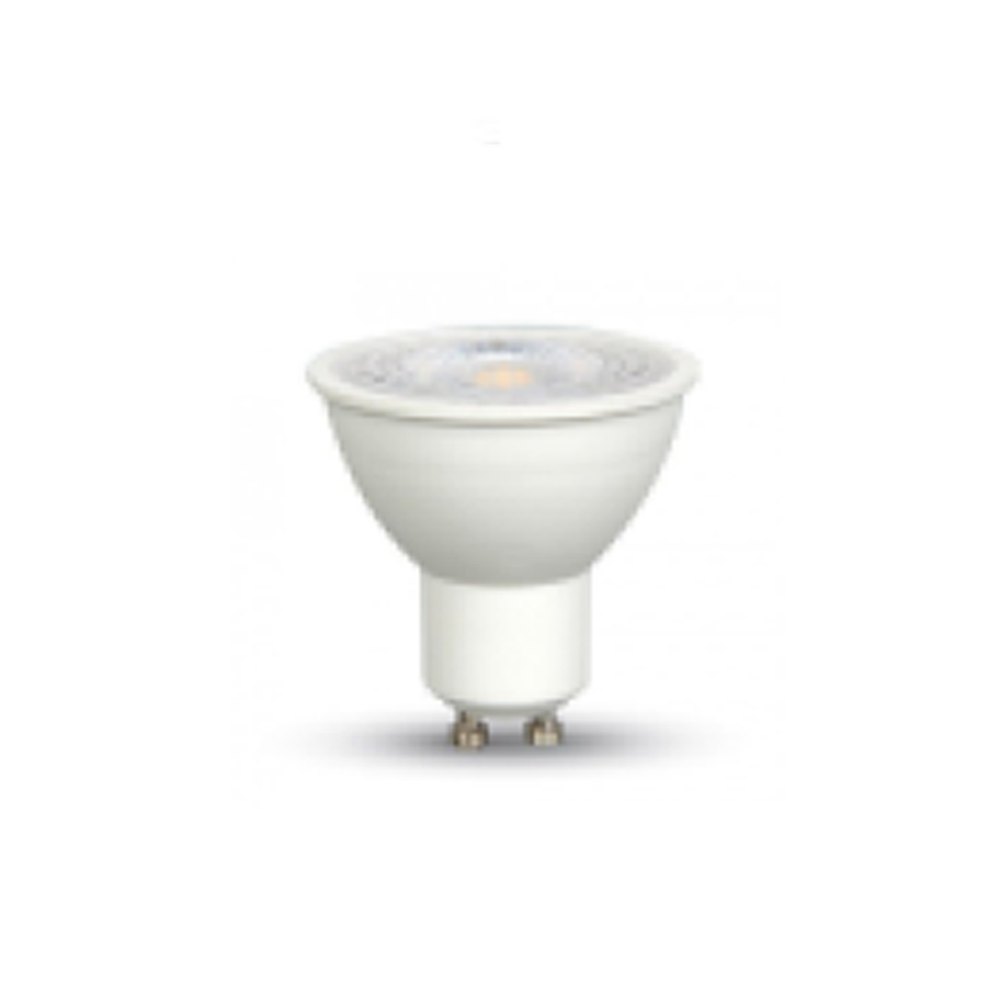
Recessed spotlights all look much the same from below: roughly 50 mm across, a flat front and a body that tapers towards the back. Behind the ceiling, though, there can be two very different systems. One runs straight off the mains, the other needs a low-voltage supply and a separate transformer. Buy the wrong lamp and it either will not go in or, worse, it goes in and then refuses to light or fails early.
The first clue: the pins
Both bases have two metal pins. The difference is their shape.
- GU10 has short, thick pins with a small flared head at each end, about 10 mm apart. You push the lamp into the holder and give it a short twist to lock it.
- GU5.3 has thin, straight pins with no flared ends, about 5.3 mm apart. The lamp simply pushes in; there is no twisting.
The numbers in the names come from that pin spacing. "G" marks a two-pin base, and "U" indicates the family designed for this kind of spotlight.
The real difference is voltage
The pin shape is only the visible side of a more important distinction. GU10 lamps normally run directly on 220–240 V mains. There is no transformer inside the fitting; the supply cable goes straight to the lampholder.
GU5.3 was originally designed for 12-volt halogen lamps. In such a system each spotlight, or a group of them, has a transformer. Today you can also find GU5.3 LED lamps rated for 220 V, so the voltage printed on the pack matters. Connecting a 12 V lamp directly to the mains destroys it instantly; a 220 V lamp fitted after a transformer will simply not light.
Reading the fitting instead of the lamp
If you cannot take the lamp out or its markings have worn off, the fitting itself often gives the answer.
- A small box next to the spotlight above the ceiling, labelled "12V", "transformer" or "LED driver", almost always means a low-voltage system using GU5.3 lamps.
- If the cable runs straight into a ceramic or plastic holder with two round slots and the lamp locks with a twist, it is GU10.
- GU5.3 spotlights are often held in the fitting by a steel spring clip: you squeeze the clip ends, lift it out, and pull the lamp off its connector from behind.
Switching from halogen to LED
With GU10 the swap is easy: remove the halogen and fit an LED lamp with the same base. The only thing to watch is size, because some LED spotlights are slightly longer at the back and may not fit a shallow recess.
With GU5.3 the transformer comes into play. Many electronic transformers made for halogen lamps do not work properly below a certain minimum load. An LED lamp draws so little power that the transformer barely registers it, and the result is flicker, blinking or no light at all. The fix is either a constant-voltage supply designed for LEDs, or a lamp whose maker states that it is compatible with that type of transformer.
The mistakes people make most often
The first is buying by diameter alone. Two 50 mm spotlights sitting side by side on a shelf can be a GU10 and a GU5.3, and the front of the box does not always make that obvious.
The second is forgetting that one home can have both systems. During a renovation the kitchen may keep its 12-volt spots while the living room gets GU10s. Buy the same lamp for every room and half of them will not fit.
The third is assuming that replacing a failed 12 V lamp solves the problem. If lamps in the same position keep failing, the cause may be the transformer or a weakened contact. Having the power supply and holder checked costs less than buying lamp after lamp.
A short check before buying
Answer these questions before you go to the shop:
- Do the pins have thick heads (GU10) or are they thin and straight (GU5.3)?
- What voltage is printed on the old lamp: 12 V or 220–240 V?
- Is there a transformer or power supply behind the ceiling?
- Is the recess deep enough for the length of the new lamp?
- If the circuit has a dimmer, is the new lamp dimmable?
Once you know these five answers, there is very little room left for a wrong purchase.
The Zəfər İşığı range includes spotlights with both GU10 and G5.3 bases. When choosing, just compare the base type shown on the catalogue product page with what your fitting takes.
All news