
MR16 and GU5.3: are they two names for the same lamp?
MR16 describes the lamp shape, GU5.3 the base. Why the two terms get mixed up so often and how to read a spotlight pack correctly.
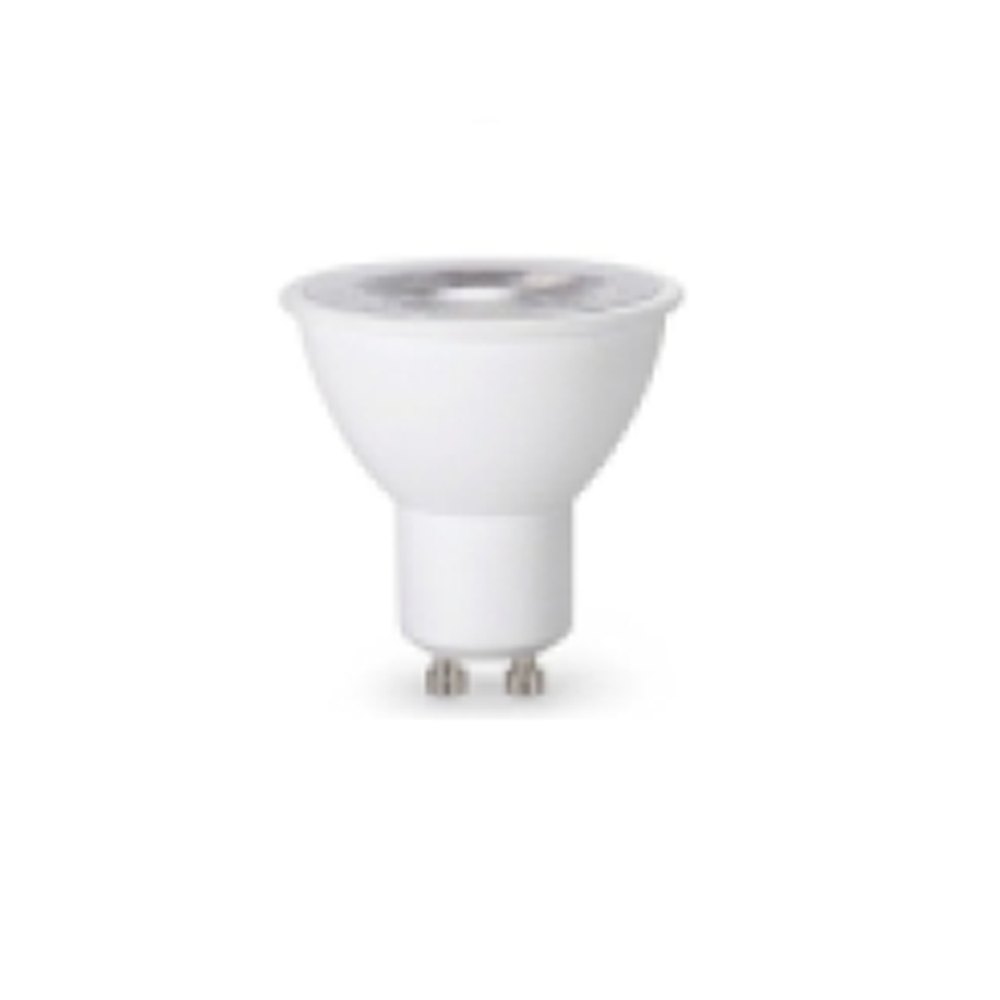
Shop for spotlights and you will see labels such as "MR16", "GU5.3", "MR16 GU5.3" and even "MR16 GU10". Some sellers treat these as synonyms, others do not. Buyers end up assuming it is one lamp with two names, and sometimes buy the wrong one. In fact the codes describe two different things.
MR16 describes the shape
MR16 refers to the body of the lamp, its reflector. "MR" stands for multifaceted reflector: in classic halogen spotlights the mirror surface that shaped the beam was made up of many small facets.
The "16" is the diameter, but not in millimetres. It is measured in eighths of an inch: 16/8 inch, which is 2 inches, or roughly 50 mm. By the same logic, MR11 is a smaller reflector lamp about 35 mm across.
So "MR16" means a spotlight with a front roughly 50 mm wide and a reflector tapering towards the back. It says nothing about how the lamp connects to the holder.
Other spotlight shape codes follow the same idea. PAR16 is a lamp with an aluminised parabolic reflector, again about 50 mm across, and it often comes with a GU10 base. R50 is a simple reflector lamp with a wider spread, usually on an E14 screw cap. The same diameter can therefore be combined with different bases, which is why a shape code never tells you on its own whether a lamp fits the holder.
In LED lamps the classic faceted mirror is often missing altogether; a plastic lens in front of the diode shapes the beam instead. The lamp still carries the "MR16" name because its outer dimensions follow the old standard.
GU5.3 describes the base
GU5.3 is the code for the connection at the back: two thin straight pins about 5.3 mm apart. This base has traditionally been used in 12-volt systems.
Because the classic 12 V halogen spotlight had both the MR16 shape and the GU5.3 base, the two names merged over time, and in everyday use "MR16" came to mean "12-volt GU5.3 spotlight".
Where the confusion causes trouble
MR16 GU10. Some sellers also call 50 mm mains lamps with a GU10 base "MR16", because the shape is the same. Strictly speaking that is correct, but the lamp uses a completely different base and voltage. A GU10 bought because it says "MR16" will not go into a GU5.3 holder, and vice versa.
Voltage. An MR16 label is no guarantee of voltage. Traditionally it meant 12 V, but 220–240 V GU5.3 LED lamps are on sale too. Choose by the voltage printed on the pack, not by the name.
Size. For LED lamps, "MR16 shape" is often approximate: the diameter is close to 50 mm, but the length can differ from the halogen original. In shallow recesses that can stop the new lamp fitting.
Open and closed fronts. Some halogen MR16s had an open front, others a glass cover, which affected how heat escaped from open fittings. With LED this matters less, but if the fitting has its own protective glass, check it together with the lamp's length.
What to read on the pack
When buying a spotlight, ignore the headline name and look at these figures:
- Base code: GU5.3, GU10, GU4 and so on; only this determines whether it fits the holder.
- Voltage: 12 V (AC/DC) or 220–240 V.
- Diameter and length: in millimetres.
- Beam angle: a narrow and a wide beam give very different effects.
- Dimmer compatibility, if the circuit has a dimmer.
How to describe your old lamp
To avoid misunderstandings in a shop or when ordering online, describe the old lamp more precisely than "MR16": for example "50 mm, GU5.3 base, 12 V" or "50 mm, GU10 base, 230 V". Those three facts let any seller find the right lamp.
The spotlights in Zaferoğlu Elektrik's Zəfər İşığı range are named by their base code, such as G5.3 and GU10, which makes it easier to choose by the base rather than the shape.
All news