
The tiny E10 cap: torches, string lights and models
Where the miniature E10 screw cap is used, what makes low-voltage bulbs different, and the subtle points such as polarity when replacing them with LED.
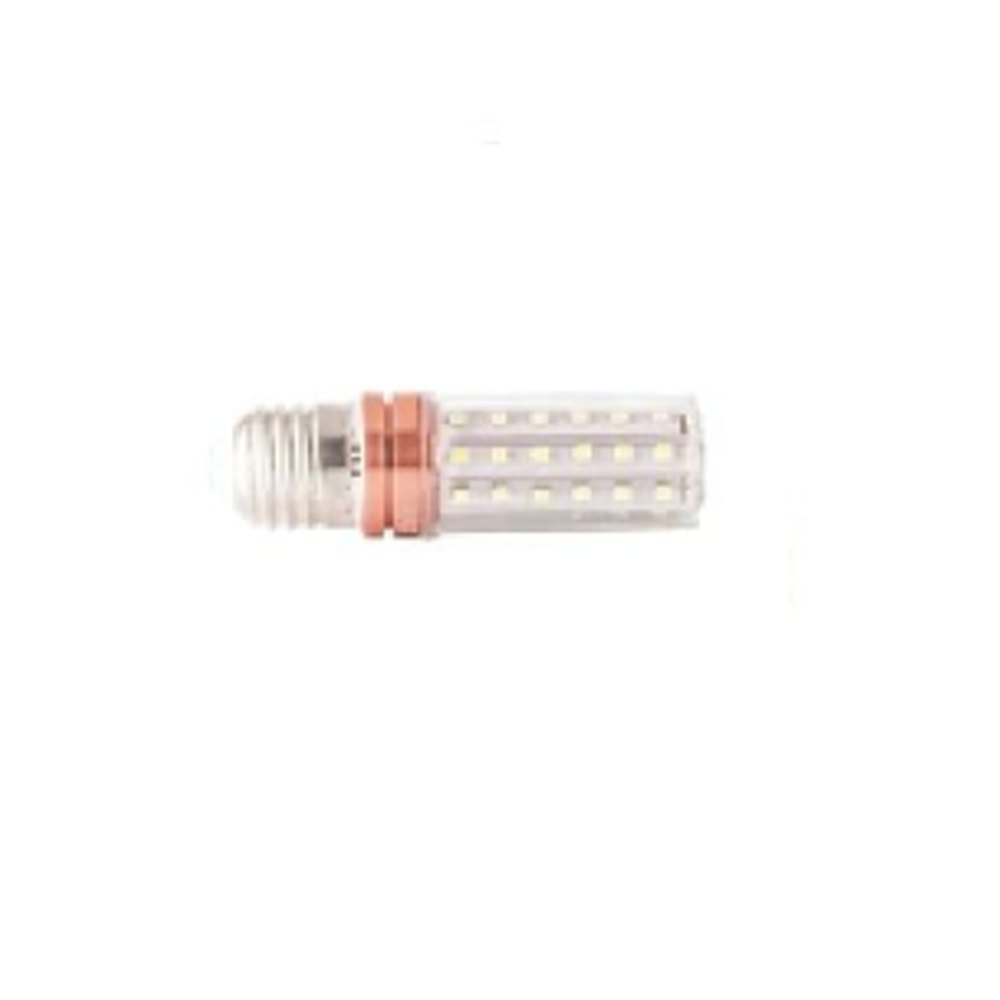
Everyone knows E27 and E14, but the Edison screw family has smaller members too. The most common of them is E10. The bulb is no bigger than a fingertip and usually works not on mains power but in devices fed by batteries or a small power supply. One day the bulb in an old torch or a child's physics kit goes out, and you find yourself facing this tiny cap.
What E10 is
The "E" stands for the Edison screw, and "10" for a thread diameter of roughly 10 mm. The construction is the same as its bigger siblings: the threaded side is one contact and the point at the tip is the other. The bulb is screwed into the holder.
E10 bulbs are usually tiny globes or pear shapes. In incandescent versions you can see a thin filament, and sometimes a thickened, lens-like tip on the glass to concentrate the light. These lensed bulbs were used in older torches to throw the light forward.
Where it is used
Today the E10 cap survives mainly in auxiliary and specialist equipment:
- Old pocket and hand torches. Most battery torches ran on E10 incandescent bulbs for years.
- Festive string lights. In some older and decorative strings, every light point is a separate E10 holder.
- Educational kits. School physics labs use small boards with E10 holders to teach electric circuits.
- Models and model railways. Lights in miniature houses and stations.
- Indicator lamps. Panel lights on older equipment and some bicycle lamps.
As the list shows, the vast majority of E10 bulbs run not on mains voltage but on a few volts.
Voltage: the most important parameter
After the cap, the first thing to check on an E10 bulb is the voltage. Bulbs that look identical are made for different voltages, such as 1.5 V, 2.5 V, 3.5 V, 4.8 V, 6 V, 12 V and so on. The figure is usually printed in small characters on the metal cap or the glass.
The effect of a wrong voltage is immediate:
- if the bulb's rating is lower than the supply, it burns very brightly and fails quickly, sometimes instantly;
- if the bulb's rating is higher than the supply, it gives a dim, reddish light or does not light at all.
In a battery device, the supply voltage can be worked out from the number of cells. Two ordinary batteries in series, for example, give about 3 V, so such torches usually take a bulb rated slightly higher, so that fresh batteries do not blow it.
Switching to an LED E10
LED replacements for incandescent E10 bulbs are available. Their advantages are clear: longer running on the same batteries, whiter light and no filament to break when the torch is knocked. There are two points to understand, though.
Polarity. An incandescent bulb does not care which way current flows. An LED, being a diode, lights only one way. If you fit an LED E10 into a battery torch and get no light, the bulb is not necessarily faulty. In some torches the centre contact is positive, in others negative. Polarity-independent LED E10 bulbs also exist, and this feature is stated on the packaging.
Voltage range. LED bulbs also carry a rated voltage. Some models work across a wide range, others only at a specific voltage. As with incandescent bulbs, the wrong voltage can destroy an LED.
Safety and practical tips
- Only fit an E10 bulb into a mains-powered device if it is designed for that device. Connecting a low-voltage bulb to the mains risks a short circuit and burns.
- If the rest of a string goes out when one bulb fails, the bulbs are wired in series. The new bulb must have the same voltage as the old one, or it will fail quickly.
- When replacing a bulb in a children's physics kit, choose one that matches the voltage of the battery supplied with it.
- Keep small bulbs out of children's reach: they are easily swallowed.
- Buying one or two spares is worthwhile, as bulbs this size are not stocked in every shop.
What to ask in the shop
When buying an E10 bulb, give the assistant three details: the E10 cap, the voltage (from the old bulb) and the shape (plain globe or lensed tip). If you want LED, mention whether the device is battery-powered and ask about polarity.
Zəfər İşığı lamps, by contrast, are meant for ordinary mains fittings in homes and workplaces rather than miniature low-voltage circuits. With low-voltage bulbs such as the miniature E10, the choice should always follow the requirements of the device itself.
All news