
“Max 60 W” on a light fitting: what it means for LED bulbs
The “max 60 W” label on a light fitting is about heat, not brightness. Here is how to read it correctly when you fit LED bulbs.
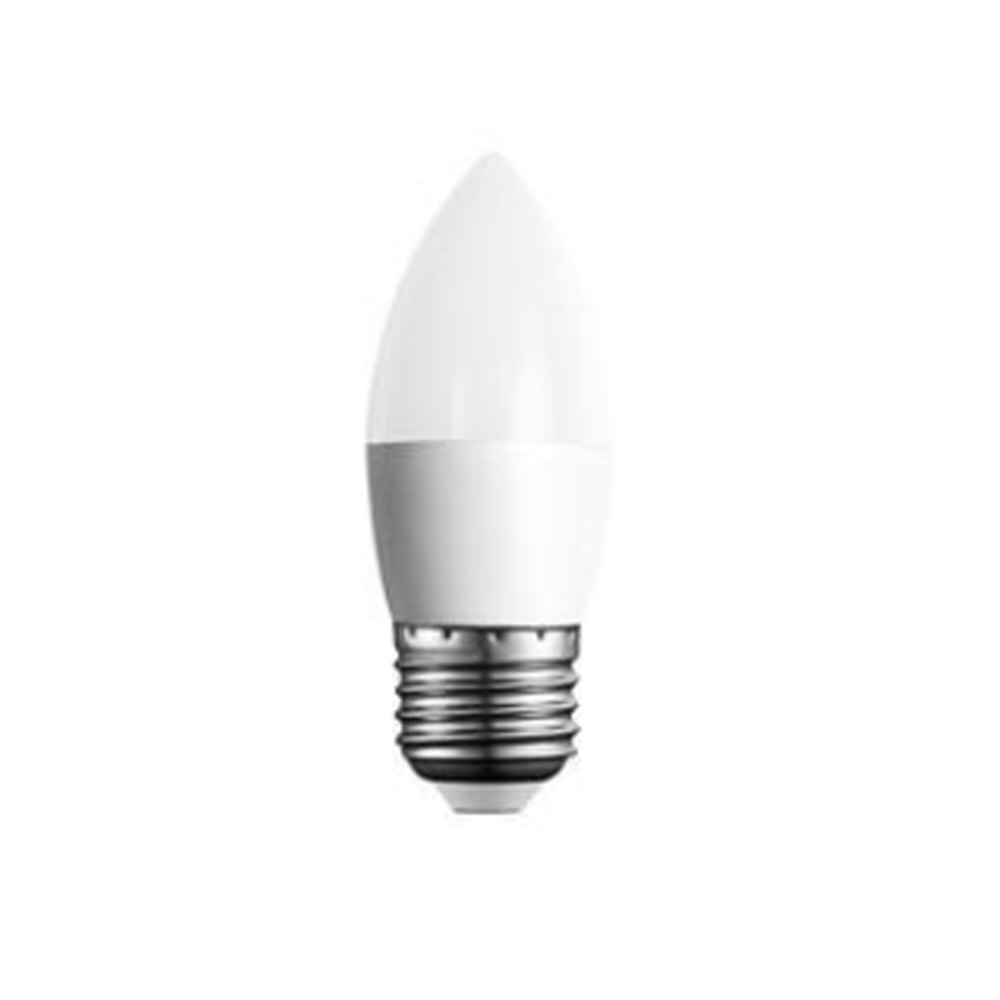
Lampholders, wall lights and ceiling shades often carry a small marking: "max 60W", "max 40 W" and so on. Many people switching to LED find it confusing. Can an LED bulb labelled "replaces 100 W" go into a "60 W" chandelier? The short answer is usually yes, but it helps to know why.
Why the limit exists
The fitting's manufacturer set that limit with incandescent bulbs in mind. An incandescent bulb turns most of the electricity it uses into heat. A bulb drawing 60 watts warms the lampholder, the wiring, the glass and the shade. The materials of a fitting, such as a plastic holder, cable insulation, a fabric shade or tinted glass, stay safe only up to a certain temperature. "Max 60 W" means the fitting was designed to cope with the heat of a bulb that consumes 60 watts.
So the marking is not about brightness. It limits the power a bulb actually draws and the heat that comes with it.
What to check on an LED bulb
An LED bulb pack usually shows two figures: the real power (say 9 W or 12 W) and an approximate equivalent ("as bright as a 75 W incandescent"). The number to compare with the fitting's limit is the real power, not the equivalent.
Example: you fit a 12-watt LED bulb into a wall light marked "max 60 W". Even if its equivalent is higher than 60 W, the bulb draws 12 watts, well below the limit. That is how an LED can give more light than the old bulb without exceeding the fitting's heat rating.
Is it really that simple?
Not entirely. Keep these points in mind:
- Enclosed shades. An LED gives off little heat, but its electronics (the driver) dislike high temperatures. In a sealed glass shade with no airflow, the bulb runs in a hot pocket of air for hours. Some LED packs carry a symbol showing the bulb is not suitable for enclosed fittings, so look for it.
- Size. Higher-output LED bulbs are sometimes longer and wider than incandescents with the same cap and may not fit inside the shade.
- Multi-arm chandeliers. "5 × max 40 W" means the limit applies to each holder. Each bulb must draw less than 40 watts.
- Dimmers. If the chandelier is on a dimmer, make sure the bulb is dimmable.
Where an LED bulb's heat builds up
An incandescent bulb radiated its heat mainly through the glass. In an LED bulb the smaller amount of heat is produced elsewhere: behind the LED board and in the body near the cap, where the driver sits. How warm that part stays has a big influence on how long the bulb lasts and how steadily it works.
That is why the bulb's position in the fitting matters. In a pendant where the cap points up and the glass hangs down, rising warm air collects around the holder and the driver. Stood cap-down in a table lamp, the bulb's base runs cooler because heat rises away from it. Narrow shades closed at the top and flush ceiling fittings make the effect stronger. In such fittings it is safer to choose a bulb whose wattage is well below the limit and, where possible, to leave space for air to move.
The opposite case: a low limit
Some small decorative fittings have a very low limit, such as 25 W. With incandescent bulbs that meant living with dim light. LED removes the problem: within a 25-watt limit you can pick a bulb far brighter than any incandescent that would have been allowed. Still, go by the real wattage and check that the bulb fits physically. Small fittings often have thin plastic holders and a shade sitting close to the bulb, so staying well under the limit makes particular sense there.
Quick checklist
- Find the limit printed on the fitting and count the holders.
- Compare the LED bulb's real wattage with that limit, not its equivalent.
- If the shade is enclosed, check that the bulb is approved for enclosed fittings.
- Measure whether the bulb will fit inside the shade or lampshade.
- Look at the holder and cables for yellowing or brittleness from years of heat; if you see it, replace the holder.
The Zəfər İşığı LED catalogue lists the real power of each model. If you would like to confirm which wattage suits your chandelier, you can contact Zaferoğlu Elektrik through the enquiry form.
All news