
Bulbs for a crystal chandelier: clear or frosted?
How much a crystal sparkles depends on the size of the light source. We explain what clear, frosted and filament lamps do in a chandelier, and how to pick cap and shape.
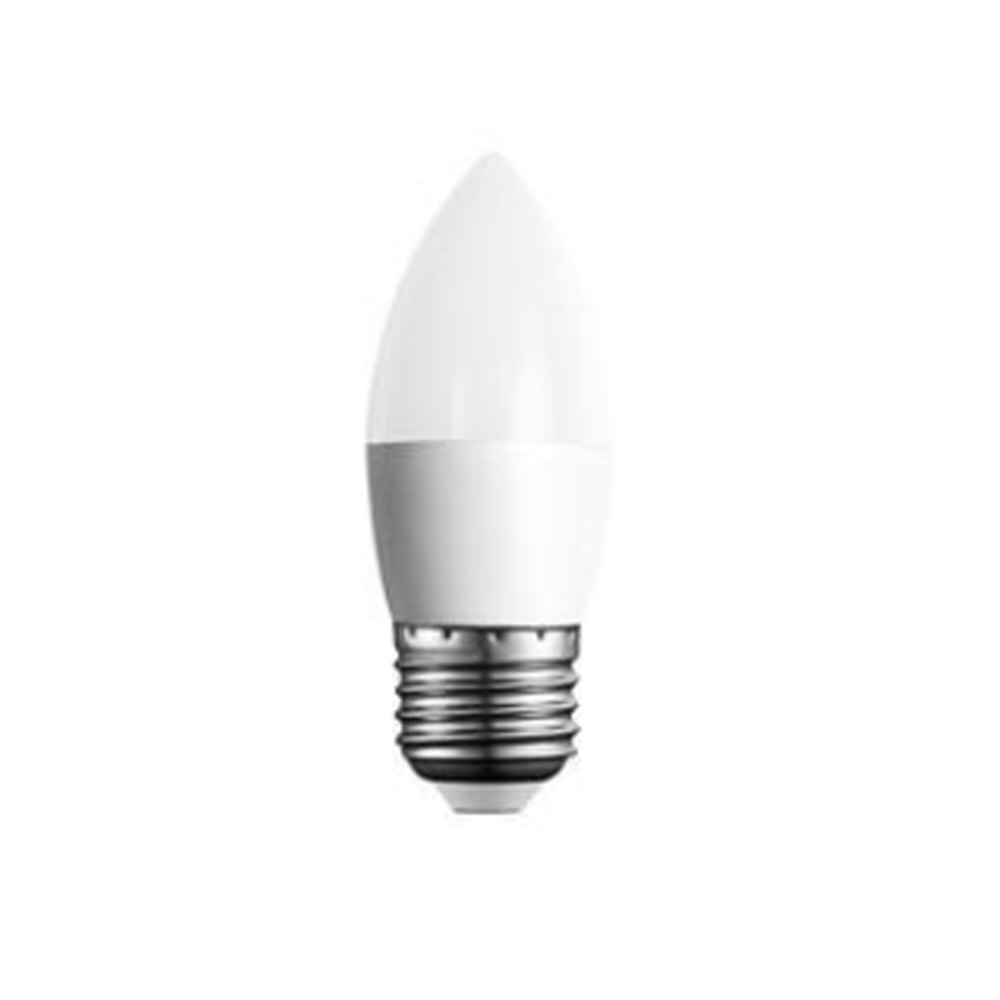
A crystal chandelier that people remember glittering with incandescent bulbs sometimes looks different after switching to LED: the drops shine, but they do not "dance", and the coloured flecks of light on walls and ceiling become fewer. The cause is often not the chandelier but the glass of the lamp. Crystal does not produce light itself; it bends, splits and reflects the light that reaches it. The more bright points it receives, the livelier it looks.
How sparkle happens
Light passing through a crystal or glass prism is refracted and split into a spectrum. For this effect to be clearly visible, the light source has to be small and bright, close to a single point. A source like that produces a sharp glint on every facet and small patches of colour on the walls.
When the source is large and diffuse, for example when the whole bulb glows evenly, light reaches the crystal from every direction. Refraction still happens, but the glints blend together, the sharpness disappears and the crystal simply looks like "lit glass". That gives the core rule: for crystal to look its brightest, the light source should be as compact as possible.
Clear lamps: for sparkle
Clear-glass lamps, especially LED filament lamps, come closest to the look of an incandescent bulb. Inside them are thin, long lines of light, and these create many sharp reflections in crystal. Advantages of a clear lamp:
- maximum sparkle in drops and prisms;
- play of coloured light on walls and ceiling;
- the classic "incandescent era" look of the chandelier.
There is a downside: a bare bright point is dazzling when you look straight at it. If the chandelier hangs low, over a table, or people often look up at it, clear lamps can become tiring. A dimmer or a slightly lower-output lamp keeps the balance.
Frosted lamps: for soft light
A frosted bulb spreads light across its whole surface. The result is no glare, even room lighting and softer shadows. A crystal chandelier then looks calmer: it still shimmers, just not sharply. Frosted lamps make sense when:
- the chandelier is the only main light in the room and everyday comfort matters;
- the lamps are fully visible through the crystal and bare points of light bother the eye;
- the chandelier hangs from a low ceiling, close to head height.
Some people go for a mix: clear lamps in the upper row near the crystal drops, frosted ones in the lower row that is directly in view. The essential condition is that all the lamps share the same colour temperature, otherwise the chandelier looks two-toned.
Shape, cap and size
Most crystal chandeliers use candle lamps with an E14 cap; larger models may take E27. Check the cap and size of the old lamp before buying new ones. Candle shapes vary too: a straight candle, a candle with a flame-shaped bent tip, a small globe. A flame tip looks decorative in classic chandeliers, while a straight candle suits simpler designs.
Size also plays a role. The body of an LED lamp can be longer or wider than the old lamp with the same cap and may get squeezed between crystal arms or stick out of a shade. With a clear lamp the internal parts are visible, so a compact, tidy filament structure is visually more pleasing.
Colour, brightness and dimming
The colour play of crystal looks more "golden" in warm white and whiter and crisper in neutral white. In classic interiors and in chandeliers with bronze or gilt details, warm white stays close to the traditional look; modern chrome-framed models can also work well with neutral white. Cool white sometimes makes crystal look harsh and clinical.
Total brightness adds up quickly in a multi-arm chandelier: six to eight lamps together can give more light than the room needs. Choosing each lamp's output with its incandescent equivalent in mind, and using a dimmer where possible, preserves the sparkle while preventing glare. If a dimmer is installed, the packaging should state that the lamp is dimmable; an incompatible LED lamp may flicker or hum.
Checks before choosing:
- is the chandelier the main light or decorative;
- do people look directly at the lamps;
- is the cap E14 or E27;
- does the lamp body fit between the crystal arms;
- do all lamps share the same colour temperature;
- if there is a dimmer, is the lamp suitable for it.
Finally, buying a single lamp to try in the chandelier is the simplest way to see the result before buying the full set.
For chandeliers, the Zəfər İşığı range includes E14 filament lamps in straight candle and flame-tip shapes, as well as the C37 E14 candle lamp. These lamps are made at Zaferoğlu Elektrik's LED lamp plant in Ganja.
All news