
How a halogen lamp works and why it runs so hot
A halogen lamp is a refined incandescent lamp: a quartz envelope and the halogen cycle make it brighter, yet most of its energy still turns into heat.
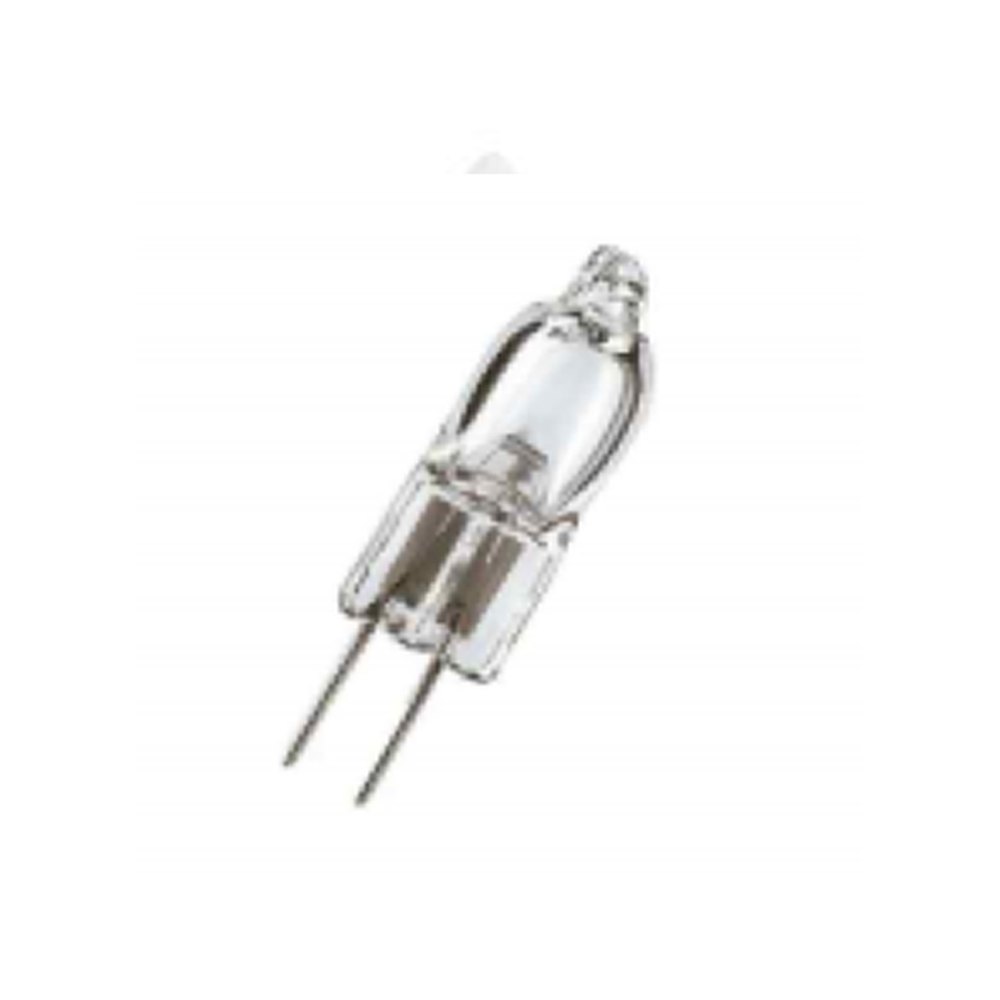
Stand under a ceiling full of halogen spots for a while and you can feel warmth on your head. You are not imagining it. A halogen lamp gets its light from a heated metal filament, and that method has a built-in drawback: the filament gives off more heat than light. To see why halogen lamps run so hot, it helps to look at how they differ from ordinary incandescent bulbs.
What it inherits from the incandescent bulb
In both lamps the light source is a tungsten filament. Electric current heats the filament to a very high temperature and it starts to glow. The hotter the filament, the whiter and brighter the light, and the larger the share of energy that ends up as light.
In an ordinary incandescent bulb, though, there is a limit to how hot you can run it. Hot tungsten slowly evaporates, the atoms settle on the cooler glass, the bulb darkens, and the filament thins until it breaks. The higher the temperature, the faster the evaporation. The halogen lamp was developed to ease exactly this problem.
The halogen cycle
Along with inert gas, a small amount of halogen, usually iodine or bromine compounds, is added to the lamp envelope. The process works like this:
- tungsten atoms evaporating from the filament drift toward the wall of the envelope;
- in the relatively "cool" zone near the wall, the tungsten combines with the halogen to form a gaseous compound;
- this compound does not deposit on the glass but circulates with the gas back toward the filament;
- near the very hot filament the compound breaks down, the tungsten is deposited back on the filament, and the freed halogen takes part in the next cycle.
As a result the envelope does not blacken and the filament can run hotter. That is why halogen light is slightly whiter and brighter than that of an ordinary incandescent bulb, and a little more efficient. Note that the tungsten does not return to exactly the same spot on the filament, so the filament still thins over time and does not last forever.
There is an important condition: for the halogen cycle to work, the envelope wall must be very hot, at hundreds of degrees. If the wall stays cool, tungsten will still settle on the glass. This is why halogen capsules are small and sit very close to the filament.
Why it gets so hot
There are two reasons, and both come from the design.
The first is physics. Most of what a heated filament radiates is not visible light but infrared, in other words heat. A halogen lamp is somewhat more efficient than a standard incandescent bulb, yet most of its energy still becomes heat. In an LED lamp the light is produced in a semiconductor, and this loss is far smaller.
The second is geometry. The small envelope sits right next to the filament and is deliberately kept hot for the halogen cycle. Ordinary glass cannot take such temperatures, so halogen capsules are made of quartz glass. With a lot of heat leaving a small surface, the lamp itself, the lampholder and the fitting all get very hot.
Rules for handling the quartz envelope
- Do not touch the glass with bare fingers. Skin oil leaves a residue that creates a hot spot on the quartz when the lamp heats up, damages the glass structure and can cause early failure or even cracking. Hold the lamp with the paper or sleeve from its packaging, a cloth or gloves. If you touch it by accident, wipe the cold lamp with alcohol.
- Never change a lamp that is on or has just been switched off. Let it cool, or burns are very easy to get.
- Keep distance from flammable materials. Curtains, timber ceilings and insulation should not be right next to a halogen spot.
- Do not remove a protective glass. Some halogen fittings are designed to be used only with a front glass; it guards against a lamp shattering and also blocks part of the ultraviolet that passes through quartz.
- Make sure the lampholder and wiring can take the heat. With a powerful halogen lamp, an ordinary plastic holder can deform over time.
Where it is still used and what replaces it
Halogen lamps dim without any trouble, render colours naturally and reach full brightness instantly. That is why you still find them in some floodlights, in large-scale industrial and construction lighting, and in fittings with big caps such as E40.
At home, replacing halogen spots with LED spots cuts both heat and energy use. Pay attention to the cap here: GU10 lamps run directly on mains voltage, while G5.3 (MR16) lamps are usually supplied at 12 V through a transformer. An older magnetic or electronic transformer may not work properly with a low-wattage LED load, so when replacing G5.3 spots, check the transformer's compatibility too.
The Zaferoğlu Elektrik catalogue includes an E40 500 W JTT halogen lamp as well as GU10 and G5.3 LED spot lamps that can take the place of halogen spots.
All news