
GX53 disc lamps: how they fit into suspended ceilings
How the flat GX53 disc lamp is built, what the recessed fitting looks like, and how to fit and remove the lamp without cracking it.
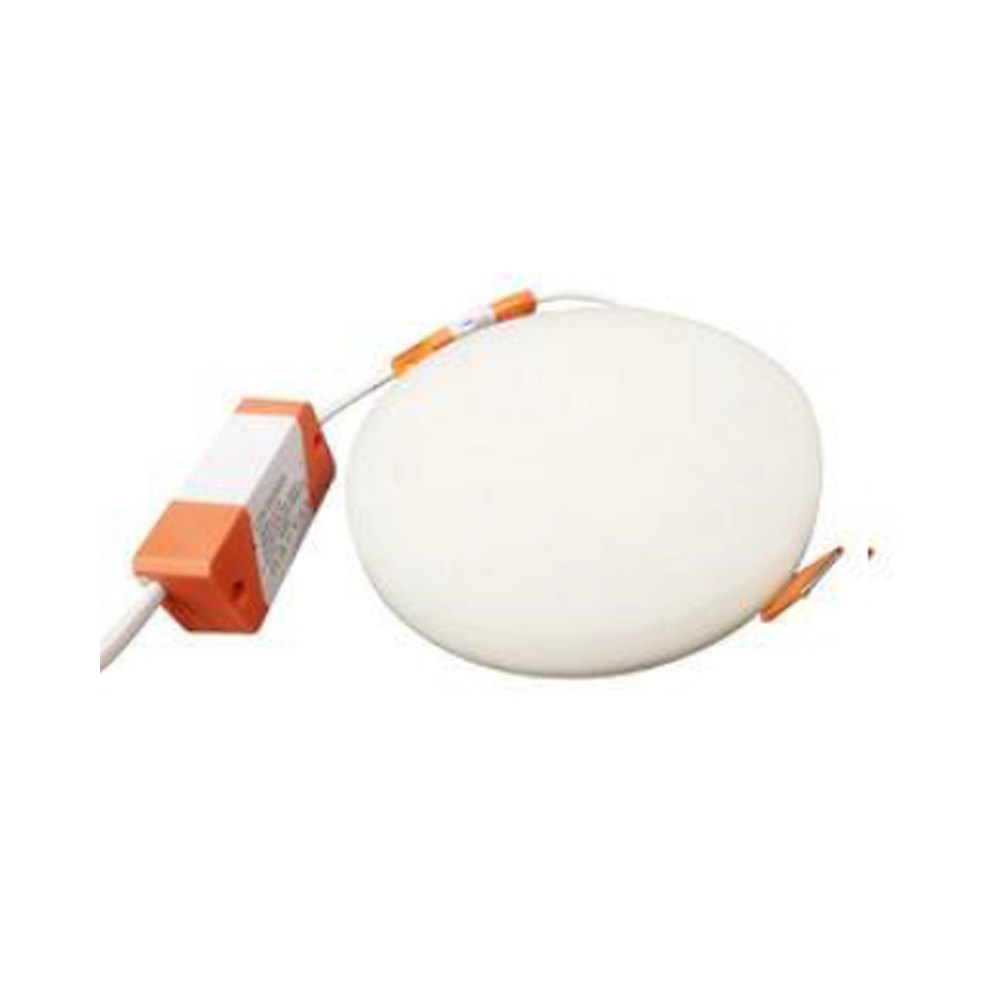
The flat round lamps you often see in plasterboard and stretch ceilings are commonly called "tablets" or disc lamps. Their technical name is GX53. The lamp is wider than an ordinary spotlight but much thinner, and that slim profile is exactly why it needs so little space above the ceiling.
What a GX53 lamp looks like
It resembles a disc, usually around 75 mm across and only a few centimetres tall. The front is covered with a frosted plastic diffuser, and two thick metal pins stick out of the back. The "53" in the name is the distance between the centres of those pins, roughly 53 mm.
In LED GX53 lamps the driver sits inside the body, and they run in fittings connected directly to mains voltage. No separate transformer is needed. That is an important difference from 12-volt MR16 spotlights: you do not have to find room for an extra unit inside the ceiling void.
The fitting and the ceiling opening
The lamp is not fixed to the ceiling itself; it goes into a GX53 fitting. The fitting consists of a ring-shaped housing, a base plate inside it and spring clips that press it against the ceiling. Installation usually goes like this:
- a hole is cut in the ceiling to the diameter stated in the fitting's instructions;
- the wires are connected to the terminals on the base;
- the spring clips are folded up, the fitting is pushed into the hole and the clips open out to hold it in place;
- the lamp is then fitted.
The hole size depends on the fitting model, because the same lamp can sit inside decorative rings of different sizes. So cut the hole to the dimension printed on the box of the specific fitting, not to the lamp.
Stretch ceilings are handled differently. The hole is cut inside a heat-protection ring glued to the membrane beforehand, and the fitting is fixed to a mounting platform installed above the ceiling. The ring stops the membrane from tearing and overheating. This is a job for the ceiling installer; cutting holes afterwards is risky.
Fitting and removing the lamp
A GX53 lamp locks on the bayonet principle. To fit it, guide the pins into the wider part of the slots in the base and turn the lamp clockwise through a small angle until it stops. To remove it, turn it the other way and pull it towards you.
A few practical tips:
- turn off the switch and, if the lamp has been lit for some time, give it a couple of minutes;
- hold the lamp by its edges, not the centre of the diffuser, since pressing the middle can crack the plastic;
- if it is hard to turn, steady the fitting with your other hand so the spring clips are not pulled out of the ceiling;
- if the pins are not fully seated in the slots, the lamp will not light or will flicker.
What to look for when choosing
Because several GX53 lamps usually work side by side in one ceiling, a consistent look matters. Buy them from the same maker and in the same colour temperature: one lamp looking yellowish and the next bluish is immediately obvious on a ceiling. A frosted diffuser softens the light, while models with a clear lens throw more directional light and can dazzle anyone standing underneath.
The height of the lamp matters too. Some fittings have a shallow housing and a thicker lamp will not sit fully inside. When buying a new lamp for an existing fitting, the simplest approach is to take the old one out and compare the dimensions.
Common problems
The lamp will not turn. Usually the pins have gone into the narrow part of the slots at an angle. Pull the lamp back slightly and seat it straight again rather than forcing it. In lamps that have not been changed for years, the plastic base may have deformed slightly from the heat; ease such a lamp out with small movements in both directions.
The fitting drops out of the ceiling. If the spring clips have weakened or the hole was cut too large, the whole housing comes down when you change the lamp. Bending the clip slightly to stiffen it, or choosing a fitting with a wider trim ring, solves the problem.
One lamp fails sooner than the others. This can point to scorched contacts in that particular base or a loose wire connection. Before fitting another lamp, shine a torch on the base; if you see discolouration, replace the fitting itself.
The light seems weak. Because a GX53 lamp is flat, it sends its light mainly downwards. In a high ceiling or a large room a handful of disc lamps may not be enough, and you may need more points or an additional light source.
Knowing the base type is the first step in choosing lamps for a suspended ceiling. If you are moving to a different spot system, the Zəfər İşığı catalogue can be filtered by base code to compare its spotlights.
All news