
How white LED light is made: a blue diode and phosphor
There is no such thing as a diode that emits white on its own. Here is how a blue chip and a yellow phosphor layer work together to produce white light.
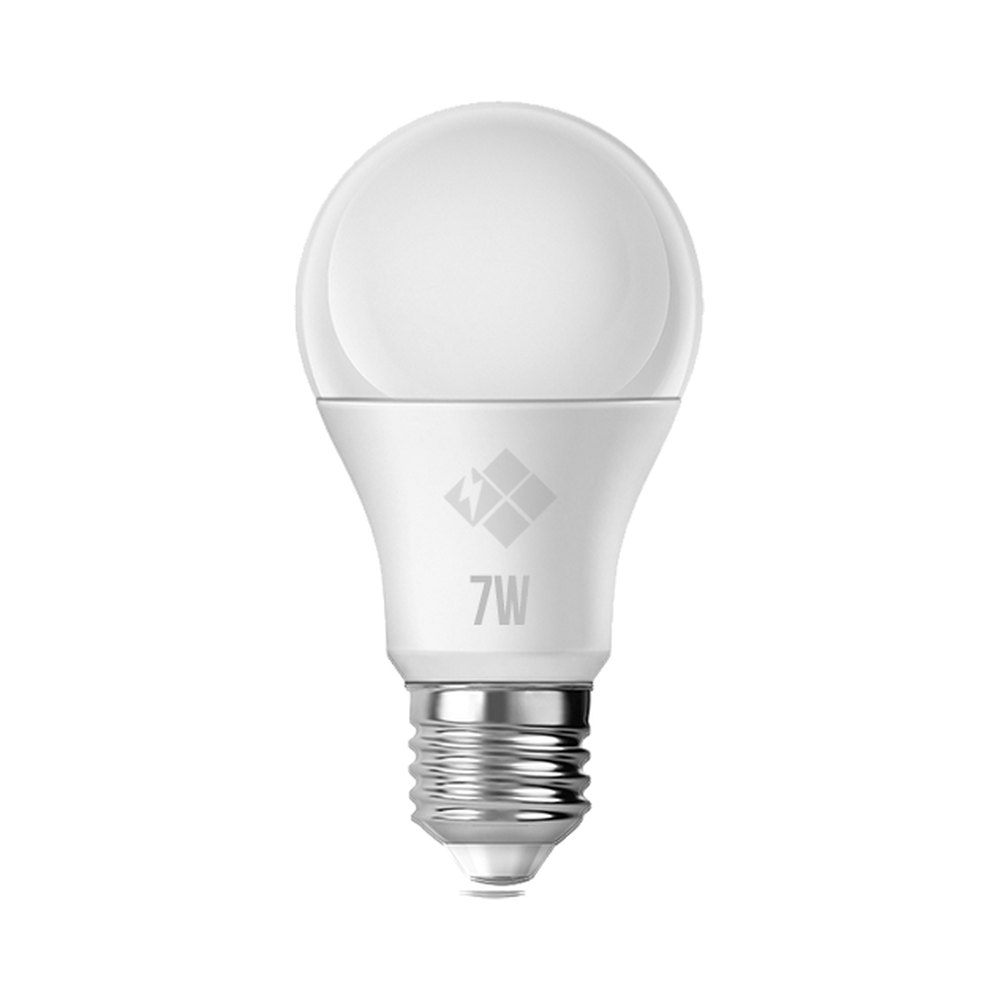
If you carefully remove the frosted dome from an LED bulb, you will see small yellow squares arranged on a circuit board. The bulb is switched off, yet these dots are yellow-orange. Switched on, it gives white light. That apparent contradiction explains the core idea behind white LEDs: the semiconductor chip does not produce white light by itself. The white appears afterwards, with the help of a second material.
Why a diode emits only one colour
A light-emitting diode is a semiconductor junction. With current flowing, electrons fall from a higher energy state to a lower one, and the energy they lose leaves the crystal as a photon. How much energy each photon carries — and so what colour we see — is fixed by the band gap of the chip material. That is why a single chip emits in a narrow band of the spectrum, in practice one colour: red, green or blue.
White light is not a single colour. Sunlight and the light of an incandescent bulb contain almost every wavelength of the visible spectrum. Our eyes also read certain mixtures of colours as white. So to get white light you either have to mix several colours or convert one colour into others.
The blue chip and the phosphor layer
The vast majority of household LED bulbs take the second route. At the heart of each one is a blue diode based on indium gallium nitride (InGaN). The chip is covered with a layer of silicone or resin mixed with a special powder called phosphor. One of the most widely used phosphors is cerium-doped yttrium aluminium garnet (YAG:Ce).
The process works like this:
- the blue diode emits blue light in a narrow band;
- part of that light is absorbed by the phosphor grains;
- the phosphor re-emits the absorbed energy at longer wavelengths, mainly in the yellow-green and yellow-orange range;
- the blue light that was not absorbed mixes with the yellow, and the eye sees the mixture as white.
This is also why an LED looks yellow when it is off: what you see is not the chip itself but the phosphor coating on top of it.
The conversion is not free. A short-wavelength blue photon carries more energy than a long-wavelength yellow one, and the difference turns into heat. That is why cooling and heat sinking in an LED bulb matter for the phosphor layer as well as for the chip.
How warm and cool white are made
Colour temperature is controlled mainly by the composition and thickness of the phosphor. With a thin phosphor layer, much of the blue light passes straight through and the light looks cool and bluish-white. With more phosphor, and with components added that emit in the red range, the blue share drops and the light becomes warm and yellowish.
There is a practical consequence. Warm white LEDs push more of their blue output through the phosphor, and each conversion wastes a little energy, so their efficiency is slightly lower. As a result, within the same product range a warm white model often has a slightly lower light output than its cool white counterpart. That is not a defect; it is simply physics.
The colour rendering index (CRI) also depends on the phosphor blend. With a phosphor that is weak in the red part of the spectrum, reds and pinks can look dull. A richer blend widens the spectrum and shows objects closer to their natural colours.
The alternative: mixing three colours
White light can also be made by running red, green and blue chips together. This approach is used in colour-changing RGB bulbs and in displays. It is rarely chosen for general lighting, because chips of different colours react differently to temperature and ageing, and keeping the balance requires complex control. A mix of three narrow bands can also distort some colours. The phosphor approach is simpler, more stable and cheaper, which is why it has become the standard in household lamps.
What matters when you buy
Understanding the technology helps you read the information on the box:
- Colour temperature in kelvin is the result of the phosphor blend: roughly 2700–3000 K for warm white, around 4000 K for neutral, and 5000 K and above for cool white.
- The CRI (Ra) value tells you how naturally colours are rendered; 80 or higher is the usual expectation for living spaces.
- Good cooling keeps the phosphor from ageing early, so pay attention to whether a bulb is marked as suitable for enclosed, unventilated fittings.
- Do not use a bulb whose dome has been removed or cracked: the dome diffuses the light and also protects the internal parts.
Household Zəfər İşığı LED bulbs have been produced in Ganja by Zaferoğlu Elektrik since 2021. Its catalogue lets you compare models by cap and shape, and the logic above helps when choosing a colour temperature.
All news